
Heavy moving equipment guide
reviews1,334 reviewsHeavy Moving Equipment in Sydney: Stair Climbers, Gantries & More
Match the equipment to each stage of the route. A stair descent, truck transfer and precise final placement can require different handling arrangements.
What equipment do specialist heavy-item movers use?
Heavy-item removals can combine several equipment types because lifting, moving across a floor, negotiating stairs and loading a vehicle are different tasks. The appropriate combination depends on the item and site.
JB’s Hercules service describes equipment options including stair climbers, gantries, HIAB-equipped trucks and dollies. Its published commercial projects also show pallet handling, a scissor lift and a counterweighted crane used for particular stages.
You do not need to name the machine to start an enquiry. Tell JB’s specialist heavy movers in Sydney what needs moving and where it needs to finish. Equipment choice follows assessment.
Stair climbers, gantries, dollies and crane-assisted handling
| Equipment type | Role that may be assessed | Site information that matters |
|---|---|---|
| Powered stair climber | Supporting an assessed load through a suitable stair route. | Item dimensions, stairs, landings, turns and transitions. |
| Gantry and suitable hoist | A planned lifting or positioning stage. | Headroom, supporting surface, working space and lifting arrangement. |
| Dollies, rollers or machinery skates | Assessed movement across an appropriate surface. | Load support, floor condition, route, gradients and transitions. |
| Pallet-handling equipment | Moving suitable supported or palletised loads. | Load base, access, surface and transfer points. |
| Crane or HIAB-equipped truck | An assessed lifting, loading or placement stage. | Site setup, reach, access, surrounding constraints and required permissions. |
| Scissor lift or tail lift | A suitable height transition or vehicle interface. | Load configuration, platform suitability and transfer space. |
This table explains purposes. It is not a capacity chart or permission to substitute one type for another. The particular model, configuration, load and operating conditions must be checked as part of the job.
Why one heavy move may need several equipment types
A device that suits the staircase may not perform the final placement. Include every stage between the original position and the destination, especially changes in height, direction or support.
From stairs to a restricted service area
JB’s published 400kg gelato-fridge project describes a stair descent followed by placement beyond a bench. The final stage used a scissor lift, ramp and specialist dolly. That example illustrates why reaching the bottom of the stairs was not the end of the job.
From transport to precise alignment
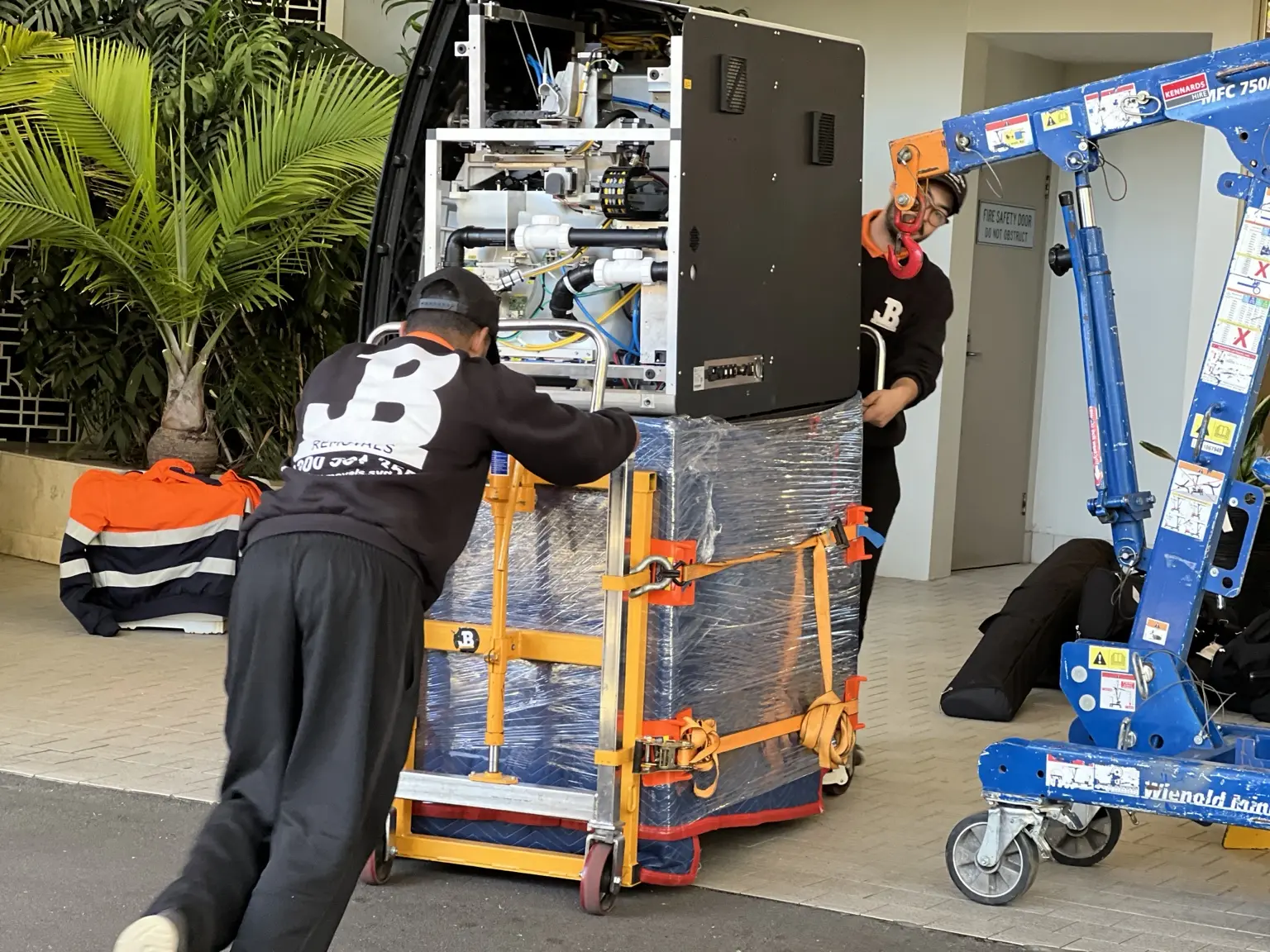
The published German dental-machine project describes a tail-lift truck and trolley for movement, then a counterweighted crane for aligning two machine sections. The hero image shows that crane-assisted stage.
Read the complete Hercules project descriptions. The equipment in those projects was selected for those particular conditions; the examples are not a universal recipe.
Why rated capacity does not confirm the whole route
A load rating does not describe whether equipment fits a doorway, has enough working space or suits the item’s shape and support needs. The assessment also considers surfaces, clearances, restraint, load characteristics and the intended configuration.
Give the assessor verified information
Share manufacturer specifications and handling restrictions where available. Separate confirmed weights and measurements from estimates, and identify any missing information.
Show the surroundings
Include the approach, overhead constraints, landings and final position. For a factory stair route, use the machinery-over-stairs assessment brief.
Safe Work Australia’s hazardous manual tasks guidance addresses risk assessment and control. Equipment selection and crew numbers should follow the assessed task, not a generic kilograms-per-person calculation.
Equipment hire or a managed commercial move?
Confirm whether you are requesting equipment hire, an operator arrangement or a managed moving scope. Identify who is responsible for item preparation, access, supporting work, transport and receiving the load.
JB’s stair-climber hire page explains its service pathways. For machinery as part of a wider relocation, discuss the whole sequence with the commercial moving team.
Ask the quote to identify the assessed equipment stages and any dependencies, rather than simply requesting the largest machine. Our crew, timing and quote guide explains what else needs agreeing.
Heavy-moving equipment questions and answers
Can a stair climber handle every heavy item?
No. The item, stair geometry, landings, surfaces, transitions and final placement must be assessed. Another handling method or access route may be needed, or the proposed move may be unsuitable.
When might a gantry be considered?
A gantry may form part of an assessed lifting or positioning stage where its setup, supporting surface, clearances and load arrangement are suitable. It is not automatically the solution for a restricted space.
Are dollies and machinery skates interchangeable?
Do not assume they are. Load support, surface, movement control and the particular equipment configuration need assessment before selection.
Will a crane solve an item that cannot fit through a door?
Not automatically. Alternative access needs assessment of the lift, site setup, building opening, surrounding constraints and any required approvals.
Can I choose equipment just from its maximum capacity?
No. Capacity is one factor. Fit, configuration, item characteristics, surface and route conditions also matter.
Does a specialist move always use one machine from start to finish?
No. Loading, level movement, stairs and final positioning may use different assessed equipment, with planned transfers between stages.
Discuss your heavy-item move with JB
Share the equipment details, both addresses, access information and preferred date. Send what you know and identify anything still to be confirmed.
More heavy-moving guides
Free moving enquiry Start in under 10 seconds
FAST, FREE MOVING ENQUIRY
Start your move in under 10 seconds.
Enter the route and date. JB will confirm the rest with you.- ✓ Two quick steps
- ✓ No obligation
- ✓ Direct to JB Sales
Need to provide the complete inventory and access details? Use the detailed moving plan →
SEARCH OR TALK TO JB